

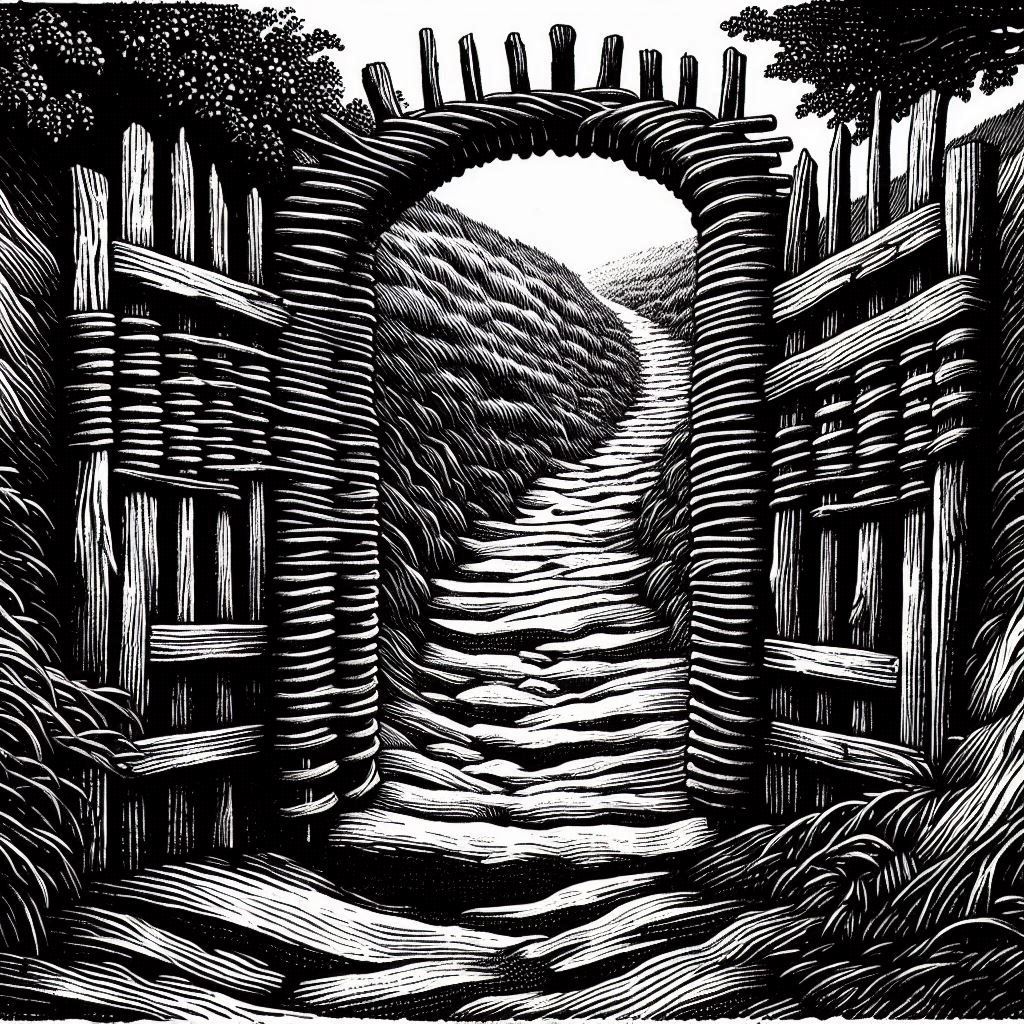
And He was passing through from one city and village to another, teaching, and proceeding on His way to Jerusalem. And someone said to Him, “Lord, are there just a few who are being saved?” And He said to them, “Strive to enter through the narrow door, for many, I tell you, will seek to enter and will not be able. Once the head of the house gets up and shuts the door, and you begin to stand outside and knock on the door, saying, ‘Lord, open up to us!’ then He will answer and say to you, ‘I do not know where you are from.’ Then you will begin to say, ‘We ate and drank in Your presence, and You taught in our streets.’ And He will say, ‘I tell you, I do not know where you are from; depart from Me, all you workers of unrighteousness.’ In that place there will be weeping and gnashing of teeth when you see Abraham and Isaac and Jacob and all the prophets in the kingdom of God, but yourselves being cast out.
Luke 13:22-28
Introduction
There are many passages that give people trouble or pause. These passages often end with phrases like, “depart from Me, all you workers of unrighteousness.” We become uncomfortable because the prospect of being rejected by God is deeply troubling.
Inherently we know that we all sin in some way (Romans 3:23), and that sin leads to death (Romans 6:23). This is self evident due to the numerous religions around the world fashioned to solve this very problem. To the Buddhist, the answer is escaping the cycle of death and rebirth (a cycle which does not exist, as we know from Hebrews 9:27). To the Muslim, the answer is following the rules of the Quran. But in Christianity the answer is different. It does not rely on anything we can do, but on the work Christ has already done on the Cross wherein He bore the consequence of sin in a great exchange, granting all those who believe His perfect righteousness (2 Corinthians 5:21).
The narrow door
If our salvation, then, is independent of our obedience, why the emphasis on a difficult path and a narrow door? A simple illustration exists earlier, in Luke 6:
Now why do you call Me, ‘Lord, Lord,’ and do not do what I say? Everyone who comes to Me and hears My words and does them, I will show you whom he is like: he is like a man building a house, who dug and went deep, and laid a foundation on the rock; and when a flood occurred, the river burst against that house and could not shake it, because it had been well built. But the one who heard and did not do accordingly, is like a man who built a house on the ground without any foundation; and the river burst against it and immediately it collapsed, and the ruin of that house was great.
Here two types of people are compared against one another: the one who merely hears the word of God and the one who does the word of God. The one who hears but does not do is one whose life is built on nothing at all. A faith that claims promises without acting on them is no faith at all. It is, in fact, counterfeit. A similar comparison is made in James 1:
For if anyone is a hearer of the word and not a doer, he is like a man who looks at his natural face in a mirror; for once he looked at himself and has gone away, he immediately forgot what kind of person he was. But one who looks intently at the perfect law, the law of freedom, and abides by it, not having become a forgetful hearer but a doer of the work, this man will be blessed in what he does.
In this passage, we see an even harsher example. The one whose life is marked by hearing without doing is likened to someone who never remembers life beyond the moment he is in. He does not remember God’s faithfulness, does not remember His commands, and does not even remember what he looks like. James expands on this point in chapter 2 when he states, “But someone will say, ‘You have faith; and I have works.’ Show me your faith without the works, and I will show you my faith by my works.” (James 2:18)
The kind of faith that saves is the very kind of faith that instills faithfulness. It is not the faithfulness that saves, mind you, but it is the marker of a saving faith.
Weeping and gnashing of teeth
The converse is, of course, a faith which produces no works, no faithfulness, and no confidence. This is the kind of faith that says, “yeah, I believe in God and I go to Church sometimes.” But it has no assurance because none can be found in a life which so despises the works and life of Christ that it would seek to crucify Him again (Hebrews 6:6). For the one whose life has no regard for the commands of God, there should be no expectancy of the everlasting blessings promised to those who call on His Name. If no repentance has taken place in our hearts, we should endure great fear that might drive us toward that repentance. Because, as we are told, outside the protection of God in His Son there is weeping and gnashing of teeth. The pain and sorrow caused by sin is immense, and without Christ that debt lies on our own shoulders.
So heed the words of Christ. Believe the words of the apostles, and make all the more certain your calling by exercising spiritual discipline. Witness the growth caused by the Spirit in your life and be blessed with the assurance that Jesus is your savior.
May the Lord bless you and conform you into the image of His Son.


Leave a comment